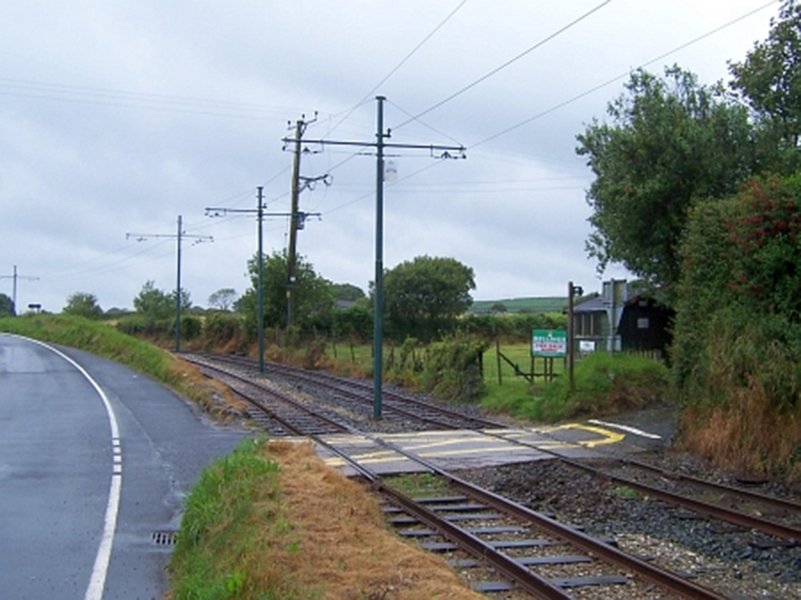
Scarffe’s Crossing, facing Derby Castle
~ SCALF FAMILY IN AMERICA ~
Origins of the Scalf Name
by Stephen Scalf
Both Henry P. Scalf in Chapter II of CHRONICLES OF THE SCALF FAMILY and Edward Scalf in Chapter I of SCALF FAMILY HISTORY point to the Isle of Man as the origin of the Scarfe name, stating that it adopted the Scalf spelling first with Lewis Scalf.
The Scarffe name continues to this day on the Isle of Man, particularly in the parish of Lonan. In fact, there is
still a stop on the Manx Electric Railway called Scarffe’s Crossing.
Scarffe’s Crossing, facing Derby Castle
However, in the Third Manx Scrapbook, the author, W. W. Gill, also discusses the existence of the English and Welsh Scarffes beginning in the latter part of the 16th century. Therefore, there is no conclusive evidence that our Scarffe/Scarfe ancestors came from the Isle of Man themselves. Since the ship manifests found in CAVALIERS AND PIONEERS by Nugent, referenced in Chapter III of CHRONICLES OF THE SCALF FAMILY all originated in England, it is just as likely that our ancestors were from England rather than the Isle of Man.
Many Scalf Family Trees available online suggest we are descended from Edward Scarfe, and that he came from the Isle of Man. However, there is no solid evidence of that relationship, nor that Edward Scarfe was from the Isle of Man. We have sufficient documentation to support that Lewis Scalf’s father was James Scarfe (b. 1710), who was the son of John Scarfe (b.1670). However, we lack any evidence concerning John Scarfe’s father. Henry P. Scalf identified several potential relatives among the transportees:
Henry P. Scalf continued, Family students believe that James Calfe was a relative, probably distant, of Moses Scarfe, Edward Scarfe, and Thomas Scafe, mentioned as transportees in CAVALIERS AND PIONEERS. It is conceivable that he [James Calfe] was the father of a John Scarfe, Pasquotank County, North Carolina, who executed a will in that county in 1751.
Although Henry regrettably failed to clarify who these family students
are, and why they believed James Calfe was a relative and possibly the father of John Scarfe (b. 1670), the fact that Henry even mentioned James Calfe as a possibility should clue us into the fact that Edward Scarfe might not be John Scarfe’s father. He also gave no explanation for why he did not include Moses Scarfe or Thomas Scafe as alternate possibilities.
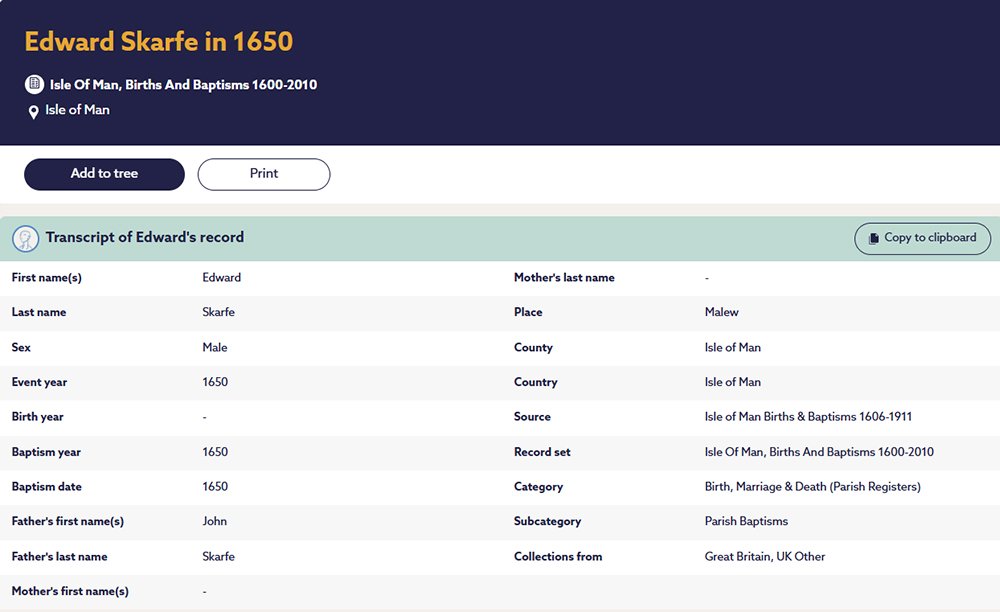
Because of the assumption that Edward Scarfe came from the Isle of Man, many began searching for records that could possible create a match. And indeed, Findmypast.com (which is the most complete source of historical records for the British Isles) has a Malew, Isle of Man parish baptismal record in Isle of Man, Births and Baptisms 1600-2010 for an Edward Skarfe dated 1650. Edward Skarfe - 1650 Baptism
As a result, we find countless family trees listing Edward Scarfe’s birth year as 1650 and John Skarfe as his father.
Let’s scrutinize this connection a little more closely:
Most indentured servants were impoverished individuals, aged 18 to 25, who had agreed to a term of four to seven years of servitude...While there were clearly some younger males whose fathers signed them into servitude, I have never found a record for one as young as 13.
While the Edward Skarfe born 1650 in Malew could possibly be the same as the Edward Scarfe transported in 1663, 1) without additional documentation we can’t assume this is the case; and 2) there is still no conclusive evidence that he was the father of John Scarfe (b. 1670).
With that said, even if we do not know his origins, we are certain that John Scarfe (b. 1670) was Lewis Scalf’s grandfather. With evidence that became available after Margaret Fleenor compiled her research, we now know that descendants of Lewis Scalf were not the only one to have the SCALF spelling. Therefore, it seems appropriate to start SCALF FAMILY IN AMERICA with John Scarfe (b. 1670), rather than with Lewis Scalf.